
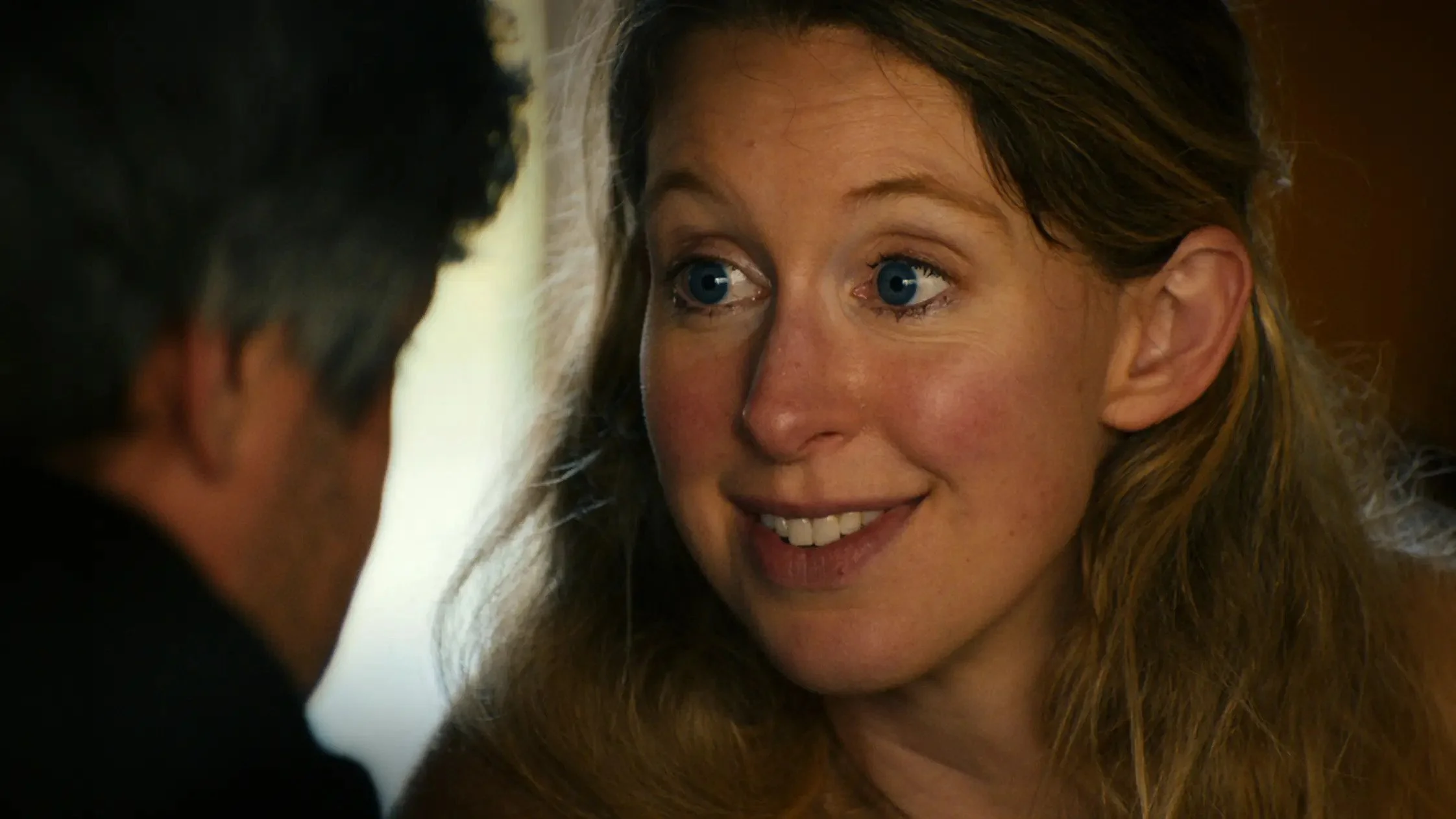
It is not often one gets to witness a masterpiece on the big screen. And not everyday one has the chance to watch Amanda Seyfried watching Elizebeth Homes watching Amanda Seyfried playing Elizebeth Holmes. You can see everything is one of those cases.
Contrary to traditional documentaries that consist of voiceovers, studio-style interviews and minimal camera work, You can see everything has beautiful cinematography, carefully engineered scores and intentional camera work. This way of filmmaking certainly paid off as it is far more engaging yet it also makes one wonder, that, if such creative power was used to manipulate the story. In 1989, the Thin Blue Line, a true crime documentary directed by Errol Morris, was not given the award by the Academy of Motion Picture Arts and Sciences simply because it featured reenactments. How much subjectivity are reenactments taking away from a documentary? In the crucial moments of the film, how much can we trust the reality the filmmakers presented us with?
Nathan Fielder was trained to become a magician. The idea of film came from a night at the Magic Castle, where an audience shouted “Elizebeth Holmes” when prompted to give a name of celebrity for a magic trick. In the rehearsal, he is known for fabricating realities and pulling off emotional manipulations and on his subjects on the show. Watching You Can See Everything felt like watching a magic trick. The magician always says “look closely” before performing a trick. They show us everything and tell us everything, then proceed to deceive and misdirect us. Every slight-of-hand is done right in front of us, yet we are left baffled, confused and even a little angry about the fact that we can so easily be deceived.
Every documentary’s objectivity is tainted by the existence of the camera. Perhaps it is a part of the human nature to behave differently when one is being observed. Every time a camera is turned on, the subjects’ behaviour inevitably becomes slightly more performative. Knowing this, one cannot help but question the motives behind asking to be filmed, 34 days before going to prison.
Most would agree that Billy was, in a way, the true “villain” of the film. He is portrayed as a narcissistic and controlling psychopath that wants to “ruin the lives of everyone” who wronged him. Somehow, subconsciously, we start to question if Elizebeth is indeed an innocent women who is nothing but a scapegoat. Perhaps her asking the film crew to document their lives is a genuine attempt to prove her innocence. Perhaps she genuinely thinks that she did nothing wrong.
But maybe that is what she wants us to see? Why should we believe anything we see considering she is literally going to prison for her manipulations?
Ask anyone who have seen the film, they probably would give a different account of what they think happened. The directors of the film have experienced this first hand. Lance Oppenheim felt that is was strange that at the end of a day of filming, everyone at the set would disagree on what exactly happened that particular day, despite witnessing the series of events unfold simultaneously.
Such is the feeling we as audience get after watching the film: was she lying? Did she do it on purpose? Maybe she really doesn’t know what she had done? The three-hour film is a roller coaster ride of cognitive dissonance. We cling on what we think is the truth, just to find it slips through our fingers.
It almost feels like that it is a documentary in which everyone is an actor.
Unlike scientific facts, the true intentions of the human interactions can almost never be proved or calculated using a theorem. There is something disturbing about the unknowability of thoughts in another person’s head. What we can do is, at best, deducing their true intentions using cues such as facial expressions. The use of telephoto lenses was exactly for this reason. The facial expressions of every subject was put under scrutiny and we could really see everything. Yet, after staring into those soulless blue eyes for minutes straight, we feel as if the more we see, the less we know.
The telling of every story is biased by the way the story is told, and therefore by the storytellers. In the case of documentary filmmaking, the filmmakers’ biases can dictate the narrative. Perhaps the deep stare into each others’ eyes doesn’t mean anything but theatrical effects. Perhaps them swimming in the ocean in the last scene shows that he truly cares about her. The prison visit reenactments are purely based on Nathan’s memories of the conversations, yet we know that no one disagrees what really unfolds in front of the camera. How much should we believe that they are objective representations of what really happened? How can we believe that the reenactments are authentic to the truth if Nathan himself was unsure about exactly what happened?
You can see everything somehow feels scarier than Obsession. It is a horror movie about the time we live in and the state of media. We live in a time when even 8 years olds know the Charlie Kirk AI song by heart, trying to fuck strangers on an island in Fiji is a real career path and most recently, flying cars. And perhaps, for once in the 99 year history of the academy awards, someone might receive the best supporting actress nomination for her appearance in a documentary.
Two people can watch the same speech given by Donald Trump and one would think he is a pedophilic racist psycho, and the other person would think he is going to make America great again. Yet, the two can still share a table at the Thanksgiving dinner. Such are our reactions after watching the film. We all live in the same reality, but perhaps, at the end of the day, we only choose to believe what we want to believe.
We can see everything, yet nothing feels real.
How fucking absurd.
Perhaps the very concept of the truth is disappearing as information overloads our prefrontal cortices. Sooner or later, AI generated images that fooled our grandparents would be advanced enough to fool us. Perhaps a day will come when we can no longer believe anything we see, and know nothing about the people around us. Perhaps knowing, would become a luxury.
Or has that day already come?